Predicting SOC
using soil spectroscopy
Infrared spectroscopy (IR) is an established
technology for rapid, non-destructive characterization of the composition of
materials based on the interaction of electromagnetic energy with matter.
IR is now routinely used for analyses of a wide
range of materials in laboratory and process control applications in
agriculture, food and feed technology, geology and biomedicine (Shepherd and Walsh, 2004; 2007).
IR enables soil-sampling density (samples per unit
area) to be greatly increased with little increase in analytical cost.
The
near and mid infrared region of the electromagnetic wage were investigated for
non-destructive analyses of soil organic carbon in western Kenya. The results
indicate hat Both NIR and MIR strongly predict carbon
concentration with some bias for higher carbon values (Figure 1). However, MIR
performed better than NIR to estimate SOC concentration.
(b) (a)
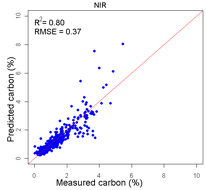
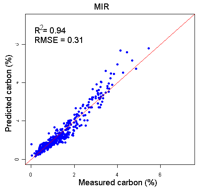
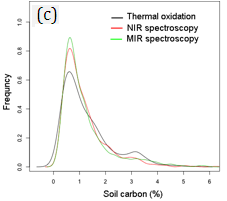
Figure
1. Partial least squares (PLS) regression analysis for: (a) NIR and (b) MIR
cross-validation using a leave one out procedure and (c) density plot showing
the reference data using the thermal oxidation and the predicted values using
NIR and MIR spectroscopy __________ Shepherd, K.D., and Walsh, M.G. 2004. Diffuse reflectance
spectroscopy for rapid soil analysis, In Lal, R., ed.
Encyclopedia of Soil Science. Marcel Dekker Inc., New York. Shepherd,
K.D. and Walsh, M.G. 2007. Infrared spectroscopy-enabling
an evidence-based diagnostic surveillance approach to agricultural and
environmental management in developing countries. Journal of
Near Infrared Spectroscopy 15:1-19.